Bowing Wall Stabilization in Columbus, OH
Carbon fiber strap and wall anchor systems for bowing or leaning foundation walls — no excavation.
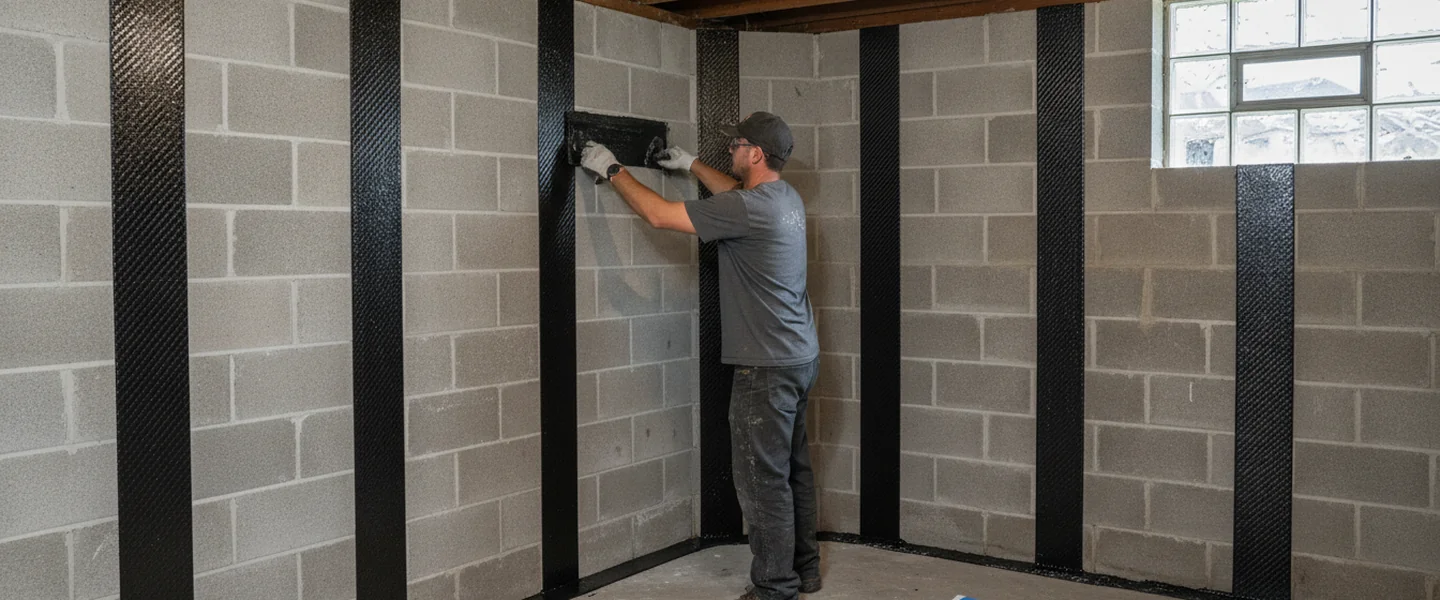
A bowing basement wall in Columbus is almost always caused by soil pressure from outside — saturated clay swelling against a poorly drained wall, surcharge from a driveway or patio installed too close to the wall, or hydrostatic pressure during heavy summer thunderstorms. Excavation and re-pour is one option, but it is expensive, disruptive, and almost never necessary on the block walls we see in Upper Arlington, Bexley, and the older parts of Hilliard. Carbon fiber straps installed on the interior — bonded with structural epoxy to a properly prepared wall surface — stop the inward movement with no excavation, no landscaping damage, and a final wall surface that can be drywalled over for a finished basement. For walls bowing more than about 2 inches, we install wall anchors instead, which actively pull the wall back to plumb. Call (614) 924-8072 for an honest evaluation.
What Bowing Wall Stabilization Means for Central Ohio Homes
Central Ohio’s humid continental climate and Franklin County’s glacial till sub-soil create a very specific set of conditions that drive the bowing wall stabilization jobs we see year after year. Spring rains saturate the clay and push laterally against basement walls. Summer thunderstorms surcharge storm sewers and back water up against foundation drains that haven’t been maintained. Fall is the calm window — dry soil, stable wall conditions, ideal for crack injection and exterior grading work. Winter’s 32-inch frost depth and freeze-thaw cycle then re-open cracks that weren’t sealed before October. Block basement walls in older Columbus neighborhoods — the 1920s Tudors of Upper Arlington, the 1910s craftsman bungalows of Bexley, the 1900s farmhouses of Westerville — are particularly susceptible to bowing because each course of block is only as strong as the mortar joint that connects it to the next course. When clay soil swells against the exterior, the wall bows inward at the mid-height and the mortar joints crack horizontally. Carbon fiber straps installed on the interior stop the bowing without excavating the exterior; wall anchors do the same job for walls already more than 2 inches out of plumb.
Project Details
| Typical Timeline | 1 day for carbon fiber straps; 2 days for wall anchors |
|---|---|
| Install Days On-Site | 1–2 days |
| Materials | Fortress Stabilization or FortressCarbon carbon fiber straps; Grip-Tite wall anchors; structural epoxy adhesive |
| Warranty | Lifetime on carbon fiber; 25-year transferable on anchors |
| Crew Size | 3 specialists |
| Permit Required | Sometimes — we coordinate |
| Pricing | Quoted per job after free on-site inspection — every quote is itemized in writing |
Our Process
- 1
Free On-Site Inspection + Measurement
We use a 4-foot level and a plumb-bob measurement to document the exact amount of bowing at multiple points along the wall. We photograph horizontal cracks and shear cracks.
- 2
Written, Itemized Quote with Strap Spacing
The quote lists exact strap spacing (typically 4-foot on center for carbon fiber) or anchor spacing for wall anchors. You see the plan before you commit.
- 3
Wall Prep
We grind the interior wall surface to bare concrete or block in a 12-inch-wide vertical band where each strap will bond.
- 4
Strap or Anchor Install
Carbon fiber straps are saturated with structural epoxy and bonded floor-to-ceiling to the prepared wall, then mechanically fastened at the top sill plate and bottom slab. Wall anchors require an exterior soil-side excavation for the anchor plate — we restore the landscaping after.
- 5
PE Letter (when requested)
We coordinate with a licensed Ohio PE who reviews the installed system and issues a stamped letter for your file — useful at resale.
- 6
Walkthrough + Warranty
We walk the wall with you, hand over the warranty card, and explain how to monitor the wall going forward.
Materials We Use
| Component | Brand | Why It Matters |
|---|---|---|
| Carbon Fiber Straps | Fortress Stabilization / FortressCarbon | Aerospace-grade carbon fiber, surface-bonded with structural epoxy to the interior wall. |
| Wall Anchors | Grip-Tite or Earth Contact Products | Steel anchor plate excavated on the soil side, connected via a 3/4-inch threaded rod to an interior wall plate. |
| Structural Epoxy Adhesive | Sika Sikadur 30 / 32 | Two-part structural epoxy used to bond carbon fiber to concrete; cures to a tensile strength higher than the wall. |
| Top + Bottom Mechanical Attachment | Hilti or Powers Anchors | Mechanical anchorage at the sill plate and slab to mechanically lock the strap top and bottom. |
Common Scenarios We See
Block wall bowed 1 inch with horizontal mortar crack
Carbon fiber straps at 4-foot on-center spacing typically arrest movement.
Block wall bowed 2+ inches with shear cracking
Wall anchors required — carbon fiber alone won’t restore the wall. We excavate, set the anchor plate, and tension.
Poured wall with horizontal crack at mid-height
Hybrid solution — polyurethane injection on the crack itself plus carbon fiber stitches across the crack for tensile reinforcement.
New bow detected during pre-purchase inspection
We provide a written assessment for the buyer’s file and a separate quote for the buyer to negotiate the seller credit.
Why Columbus Homes Need Bowing Wall Stabilization
The pre-1970s block basement walls common in Upper Arlington, Bexley, Westerville, Clintonville, and the older sections of Hilliard are particularly prone to bowing because each mortar joint is a tensile-weak link. When the Franklin County clay swells in spring against an exterior backfill that was never properly compacted, the soil pressure exceeds the tensile capacity of the mortar joint and the wall starts to bow inward. Once it starts, it does not stop on its own; carbon fiber straps or wall anchors are the only reliable way to arrest the movement.
Warranty in Detail
Carbon fiber straps carry a Lifetime warranty (transferable to the next homeowner). Wall anchors carry a 25-year transferable warranty. What is covered: any new inward movement of the wall beyond the documented bow at install (we measure and photograph the wall at install for the baseline). What is explicitly not covered: existing aesthetic cracks already present in the wall at install (we document and quote a separate cosmetic patch if you want it), water entry through the wall (separate waterproofing scope), or movement caused by major exterior changes (driveway expansion, new patio against the wall, large tree planted close to the foundation).
How We Quote (Without Quoting on the Phone)
We never quote bowing wall stabilization sight-unseen. Anyone who gives you a price over the phone is either undercutting on something critical (skipping crack repair before waterproofing, undersizing pier counts, hand-waving warranty exclusions) or padding the quote so heavily that they can drop the number once they are in your kitchen. We do not play that game. Every quote starts with a 45-minute on-site inspection: we measure, we photograph, we look at things your neighbor’s contractor probably skipped, and then we write the quote line by line so you can compare it apples-to-apples against anyone else you talk to. Call (614) 924-8072 and we will get you on the schedule.
After the Install
At 30 days we re-measure the wall at the same documentation points used at install. If the measurements are stable, you sign off. If they have changed (extremely rare), we add reinforcement at no charge. At 12 months we re-measure again as part of the warranty file.
Frequently Asked Questions
How do I know if my wall is bowing?
Look for horizontal cracks at mid-height, stair-step cracks along block mortar joints, visible inward lean when sighted along the wall from a corner, or wall surfaces no longer plumb when checked with a 4-foot level. We document with measurements at install so we know exactly where you started.
Carbon fiber vs wall anchors — which is right for my wall?
Carbon fiber arrests the bow where it is — it stops further movement. Wall anchors actively pull the wall back toward plumb. We use carbon fiber when the bow is under about 2 inches; wall anchors when the bow exceeds 2 inches or when we want to recover lost interior space.
Can I drywall over carbon fiber?
Yes — the straps sit flush on the wall surface and are easily covered by furring strips and drywall. Most of our finished-basement homeowners do this.
How much does bowing wall stabilization cost in Columbus, OH?
Quoted per job after a free on-site inspection. Cost depends on wall length, strap or anchor count, and whether we need a PE letter. Call (614) 924-8072.
Will it damage my landscaping?
Carbon fiber straps are an interior-only install — zero landscaping disturbance. Wall anchors require an exterior excavation per anchor (typically 3 ft wide x 5 ft deep); we restore the soil and any disturbed lawn or beds.
Is the warranty really lifetime?
Yes for carbon fiber straps (manufacturer Lifetime, transferable). Wall anchors carry a 25-year transferable workmanship warranty.
How long does the install take?
Carbon fiber: 1 day for a typical wall. Wall anchors: 2 days including the soil-side work.
Do you provide an engineering letter?
When requested — yes. We coordinate with a licensed Ohio PE who reviews the install and issues a stamped letter for your file. Useful at resale or for HOA documentation.
Can the wall be fully restored to plumb?
With wall anchors and patience (sometimes tensioning over multiple visits), yes — we can typically recover most or all of the bow. Carbon fiber holds the wall where it is.
Related Pages
Other Foundation Services
Service Areas We Cover
Get a Free Written Bowing Wall Stabilization Quote
Same-week appointments across Franklin, Delaware, and Fairfield County. No high-pressure sales — just a written, itemized quote after a 45-minute on-site evaluation.
What You Get in Our Quote vs. the Lowball Bid
We don’t compete on the lowest sticker price — we compete on the quote that gets the job actually done. Here is what is included in every quote we write, and the cut-corners that show up in cheaper bids.
Included in our written quote
- Engineer-style elevation + crack assessment
- Soil and drainage evaluation
- Written quote with pier counts + warranty terms
- Photo documentation of every crack/movement
- Permit-pulling where required
- Post-install elevation re-check
Cut corners in the lowball bid
- Free-quote with no actual inspection
- Pier-count guesses without measurements
- Subcontracted installation crews
- Warranties that exclude common failure modes
- Pressure to sign at the kitchen table
- Same-day pricing tricks